
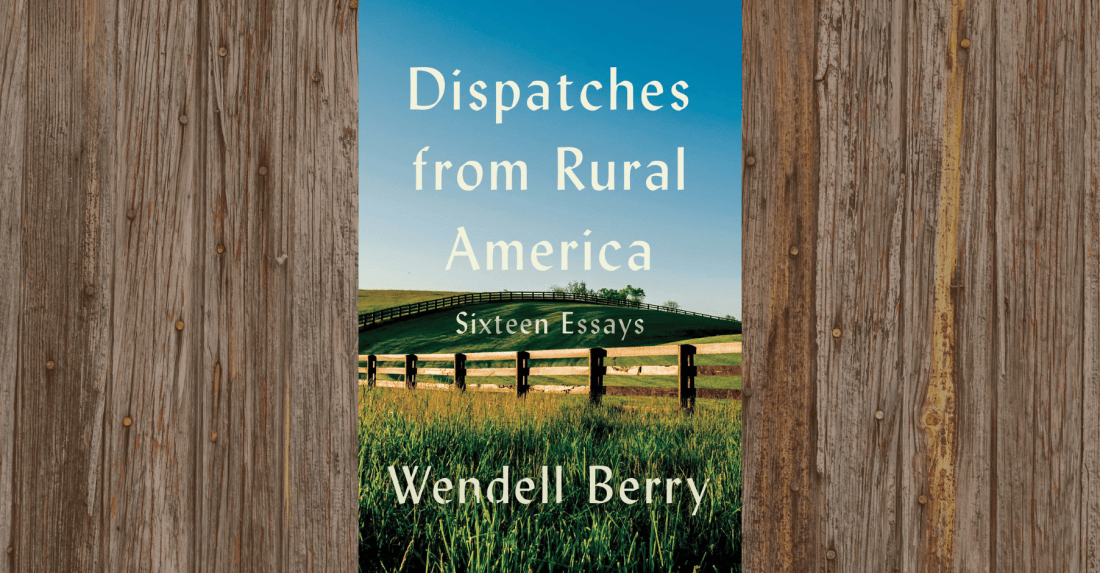
The essay collection, Dispatches from Rural America, by Wendell Berry, is a milestone release, with its publication date falling around the 50th anniversary of Berry’s influential and groundbreaking book, The Unsettling of America: Culture and Agriculture, in which he first addresses many of the central themes in this newest work: the crisis of American agriculture and a turning away from traditional caretaking of our land to massive industrial exploitation. The significance of this collection is even more notable given Wendell Berry’s passing on August 31, 2026, just a few months before the release of what is now his final literary work.
In his opening essay, “Against Killing Children,” he states plainly that “the manifestations of our destructiveness are related…all parts of one thing: a global corporate economy concentrated upon the effort to turn to profit everything that can be subdued to its methods.” The sixteen essays span topics from the costs of modern warfare and industrial expansion to unbridled modern progress and the loss of connection within communities, especially rural America. At the core, Berry’s values have not wavered, but as readers will see in this new essay collection, they have sharpened over time through Berry’s observations of the continued cost of industrial progress, a pursuit that seems to permeate every part of American culture. With so much debate about AI today, the essays offer a timely perspective on what’s at stake if we, as a society, view progress at any cost as good and thus lose our relationship to the natural world, our land, and each other.
In the essay “The Problem Is Industrialism,” Berry recalls several conversations with a longtime friend, Wes Jackson. They discussed calamities and scandals circulating in the media, yet concluded that these issues stem from one larger problem. “Properly understood, they are symptoms of a problem. The problem is industrialism — or its parthenogenetic offspring, the industrial economy — which, by using a progression of technologies to increase profits, ignores and transgresses every limit, denies the issue of scale, and discounts every nonmonetary cost.”
Berry remarked, “It ‘grows’ only by consuming, once and for all, the living world. Industrialism, in short, is an anomaly in all creation, unnatural, inhuman, dehumanizing. Its most characteristic ‘business’ is industrial war. Its distinguishing sign is waste. Because of industrialism, there are now millions of people who have never heard silence or seen anything beautiful.” He goes on to say that we are “destroying the world by the industrial way of life that all of us are living.” It certainly makes one consider and reflect on life and what is truly valuable. More specifically, after reading these essays, I feel compelled to consider what we don’t want to lose from the past, or a simpler way of living, as our wants, both personally and as a society, continue to grow.
Berry encourages readers to see life as a way of being connected to others and to community. If something is good for the community, it is good for the individual. Yet, according to Berry, that way of thinking largely runs counter to the industrialized society we find ourselves in. In the essay, “Wild and Domestic,” he writes, “We, the industrial consumers of the world, are the wild ones, unrestrained and out of control, self-excluded from the world’s natural home making and living at home…To that world we strangers can come home only by obeying both Nature’s laws and the specifically human laws adding up to self-restraint and love for neighbor.”
In his final essay, “The Story of Our Sheep Flock,” Berry described life with his wife, Tanya, on their farm in Henry County, Kentucky. Long known for his position on agriculture, he was a self-proclaimed agrarian, and I would say he practiced what he preached. Through trial and error, and driven by a desire to care for their land, Berry and his wife learned to raise animals and tend to the land they’d acquired. He shared in detail the time and energy it took to put his agrarian philosophies into practice and see how they affected their day-to-day farm operations. In all his learning and in his life, he said that he’d learned a few good rules: “Do everything you can think of to reduce expenses. Consider advice, but do your own thinking. Use no purchased equipment or solution that you can make for yourself or do without. Don’t be too eager for something better than what you already have. Accept all you can of the free helps of Nature, whose first law is Waste Nothing.”
If words could be likened to seeds that are planted in the ground, then Wendell Berry — his voice, his thoughts, his written words are planted deeply in the soil of American Literature. And if anything, his words call us not just to contemplate, but to put into practice a way of living that we will lose if we continue pushing toward progress at any cost. To quote one of my favorite poems of his from his collection called A Timbered Choir: The Sabbath Poems, “The seed is in the ground. Now may we rest in hope. While darkness does its work.” May we hope that the seeds of the words he planted throughout his life will grow in us and produce another way of living, of being, of seeing in the world. One that sees the value in personal contentment and in caring for the communities around us. That seems like a good place to start to me.
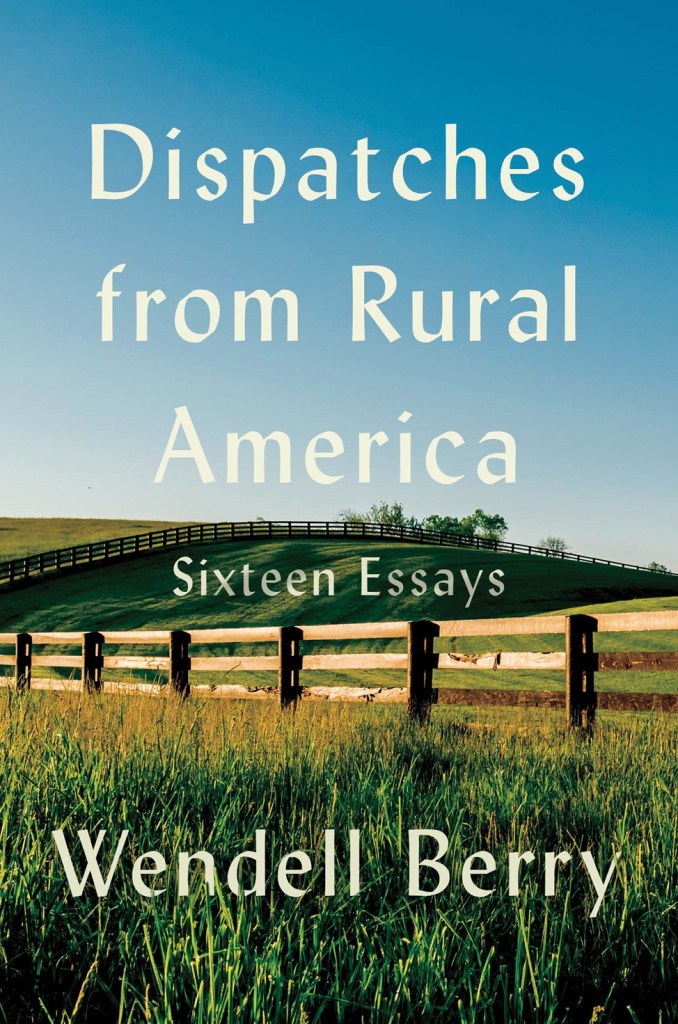
Dispatches from Rural America
By Wendell Berry
Counterpoint
Published October 27, 2026


